


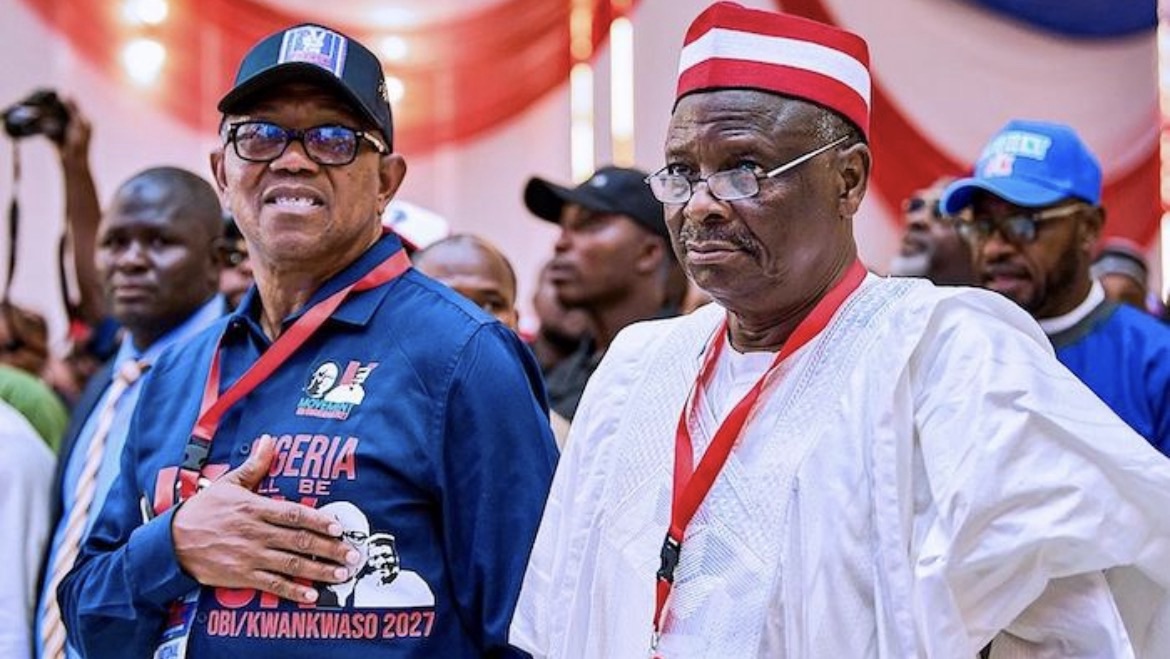
Fresh controversy has erupted within Nigeria’s opposition camp after the Obi-Kwankwaso Movement criticised the Nigeria Democratic Congress (NDC) over the composition and timing of its campaign council for the 2027 general elections.
In a report published on Tuesday, October 27, The Guardian said the movement questioned whether the NDC had built the grassroots structures needed to support its national campaign machinery.
The criticism followed the NDC’s announcement of its National Campaign Council, chaired by former Bayelsa State governor Seriake Dickson, with presidential candidate Peter Obi as co-chairman and Rabiu Kwankwaso as co-vice-chairman.
The party said the council would coordinate campaign activities, strengthen mobilisation across the country and promote its policy agenda ahead of the elections.
However, OK Movement Director-General John Ughulu argued that announcing prominent names was not enough without an effective network of supporters at state, local government, ward and polling-unit levels.
He also maintained that the movement had developed organisational structures that should not be treated as a mere extension of the party’s campaign machinery.
NDC discloses ₦6.13bn balance
The report also highlighted the NDC’s financial position. At its National Executive Committee meeting in Abuja, the party disclosed that it had retained approximately ₦6.13 billion from reported inflows of ₦8.53 billion and spent about ₦2.4 billion on its activities.
The party’s treasurer, Peter Onigah, appealed for additional contributions to finance its operations and election preparations. Party officials described the remaining funds as an important reserve but acknowledged that further resources would be needed.
The disclosure has added a financial dimension to the debate over the party’s readiness for the forthcoming elections.
A test of opposition coordination
The disagreement exposes a challenge facing the opposition: how to coordinate party leadership, campaign organisations and grassroots support without creating competing centres of influence.
The NDC says its campaign council will provide a central structure for its electoral efforts, while the OK Movement has questioned whether the party’s organisation is sufficiently developed.
Neither the criticism nor the party’s financial disclosure alone establishes how effective its eventual campaign will be. That will depend on how the structures operate and how well the party coordinates its supporters in the months ahead.
