


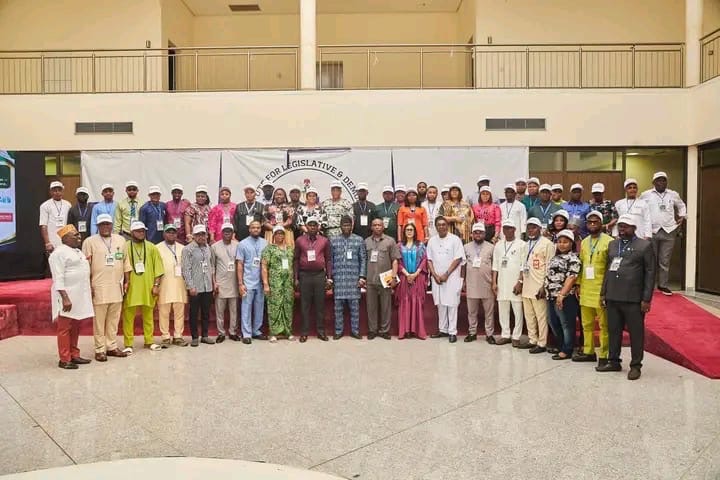
The lawmaker representing Oron/Mbo/Okobo/Udung Uko/Urueoffong Oruko Federal Constituency in the House of Representatives, Rep. Martins Esin, has sponsored a two-day capacity-building programme for 52 councillors to strengthen legislative practice and improve local government administration in Akwa Ibom State.
The programme, organised by the National Institute for Legislative and Democratic Studies (NILDS), commenced on Tuesday with the theme, “Strategic Leadership, Developing Legislative Practice and Procedures for Effective Local Government Administration in Nigeria.”
The initiative is aimed at equipping the grassroots lawmakers with the requisite knowledge, skills and leadership capacity to perform their legislative functions effectively and improve service delivery in their respective local government areas.
Speaking at the opening ceremony on behalf of Rep. Esin, Barr. Omen Bassey, Press Secretary to the Deputy Governor of Akwa Ibom State, said the neglect of local government administration had contributed significantly to the challenges of poverty and hunger in the country.
He commended President Bola Tinubu for insisting on local government autonomy, stressing that strengthening the third tier of government was essential to promoting development and delivering democratic dividends to the people.
Bassey urged the councillors to take full advantage of the training, describing them as potential leaders whose responsibilities and influence would continue to expand.
He expressed confidence that the knowledge acquired would translate into tangible improvements in legislative performance, accountability and service delivery when the participants returned to their respective councils.
Also speaking, the Director-General of NILDS, Prof. Abubakar O. Sulaiman, represented by the Institute’s Director of Internal Audit, Mr David Akinyemi Osanaiye, commended Rep. Esin for investing in knowledge and capacity development at the grassroots.
He said the programme would contribute to improved public service and more effective representation across the constituency, noting that the riverine nature of the area required strategic and context-specific approaches to development.
Osanaiye described councillors as some of the most accessible public officials in the country, observing that their proximity to the people placed them in a strategic position to understand community needs and strengthen the relationship between government and citizens.
He added that building the capacity of grassroots lawmakers was crucial to deepening legislative knowledge, strengthening local government institutions and ensuring that democracy delivered meaningful benefits to the people.
In his remarks, the Chairman of the Oron Federal Constituency Councillors Forum, Hon. Sunday Effiong Eyo, described the training as an unprecedented opportunity for grassroots lawmakers to enhance their knowledge and legislative performance.
He thanked Rep. Esin for sponsoring the programme, expressing optimism that the lessons would help participants overcome legislative challenges and discharge their constitutional responsibilities more effectively.
The opening day featured technical presentations on lawmaking procedures, security, budgeting and the operations of legislative committees at the local government level.
Dr. Samuel Oguche, Deputy Director of Legislative Support Services at NILDS, examined the lawmaking process at the local government level, including legislative instruments, motions, resolutions, public hearings and investigations.
Prof. (Associate) Hakeem Onapajo of the Legislative Centre for Security Analysis discussed Nigeria’s security architecture and state policing, highlighting related issues, challenges and prospects.
The session on budget and appropriation processes, including financial and administrative autonomy for local government areas, was delivered by Dr. Asimiyu Abiola, Director of Studies at NILDS.
Similarly, Dr. Mohammed Amali, Senior Research Fellow in Legislative Support Services at NILDS, addressed the types, composition, operations and procedures of committees in local government legislative councils.
The presentations were complemented by interactive sessions, providing participants with opportunities to engage the resource persons and examine practical challenges associated with legislative responsibilities and local government administration.
The programme is expected to deepen the councillors’ understanding of legislative procedures, budgeting, oversight and institutional accountability, thereby strengthening grassroots governance and improving the delivery of public services across the constituency.
