


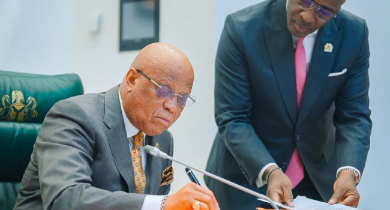
…How a thoughtful gesture to retirees reinforces the Governor’s reputation for compassionate, people-centred leadership
There is a profound difference between a government that remembers its citizens during their productive years and one that continues to care for them long after they have left the workforce. The true measure of responsible leadership is not merely how much infrastructure is constructed or how many projects are commissioned, but also how deliberately those who contributed to building the society are protected when age and retirement make them more vulnerable.
This is the significance of Governor Umo Eno’s approval of a 13th month pension bonus for all pensioners in Akwa Ibom State, alongside a one-time ₦10,000 welfare support for November 2026. Beyond the monetary value of the intervention, the gesture speaks to a leadership philosophy that recognises the elderly, appreciates years of service and understands that the dignity of retirement must be protected.
At a time when the cost of living continues to place considerable pressure on households, particularly those dependent on fixed incomes, the Governor’s announcement offers a welcome financial cushion to thousands of retired public servants across the State. For people whose active working years are behind them and whose monthly pensions constitute their primary source of livelihood, an additional payment at this period is more than a bonus. It is an opportunity to meet obligations that may have been deferred, replenish household essentials, attend to health needs and approach the coming months with a little more financial confidence.
The importance of the intervention becomes clearer when viewed against the peculiar circumstances of retirement. Unlike serving workers, pensioners generally have limited opportunities to supplement their income through regular employment. Their financial responsibilities, however, do not end with retirement. They still have families to support, medical bills to settle, household expenses to meet and personal needs that become increasingly demanding with age.
For some, the 13th month bonus could mean purchasing essential medication without having to make difficult choices. For others, it could provide additional food supplies, support grandchildren’s educational needs, settle outstanding bills or offer assistance to dependants. Even where the amount does not resolve every financial challenge, the assurance that government has made a deliberate provision for their welfare carries considerable emotional and psychological value.
This is where Governor Eno’s intervention distinguishes itself. It is not simply about putting additional money into the pockets of retirees; it is about recognising their humanity and making them feel valued after decades of service to the State.
Interestingly, the Governor did not stop at approving the 13th month pension bonus. He further directed that an additional ₦10,000 be paid to every pensioner alongside the November 2026 pension. The decision, announced spontaneously during his interaction with the pensioners at Ibom Hall Ground, Uyo, on October 30, reflects a disposition towards humanitarian interventions that goes beyond routine administrative obligations.
It is this ability to anticipate needs and respond with timely gestures that has increasingly become an important feature of the Umo Eno administration. Rather than waiting for vulnerable groups to reach a breaking point before responding, the Governor has consistently demonstrated an inclination to place their welfare within the priorities of governance.
Indeed, the 13th month pension bonus should be viewed within the context of a broader welfare commitment that has also seen the administration confront one of the most painful legacies inherited in the State’s public service: unpaid gratuities.
For years, retired workers had carried the burden of accumulated gratuity arrears dating back to 2012. For many of them, the delay meant spending the most important years of retirement without access to the financial benefits they had earned through years of dedicated service.
Governor Eno’s decision to confront this liability has produced a remarkable outcome. According to the Governor, his administration has so far released ₦100 billion out of the inherited ₦111 billion gratuity backlog, leaving approximately ₦11 billion outstanding. He has assured that the balance will be cleared before the end of his first term.
This is particularly significant because gratuity is not a favour bestowed on retirees by government. It is an earned entitlement, representing part of the financial reward for years of service. Its timely payment enables retirees to make important financial decisions, establish small businesses, settle family obligations and create some measure of security for their later years.
By committing substantial resources to the settlement of these arrears, the Eno administration is addressing an old injustice while restoring confidence among workers who will eventually retire from public service.
Another important dimension of the Governor’s elderly welfare agenda is the State Health Insurance Scheme, which he encouraged pensioners to embrace, noting that residents aged 65 and above enjoy free coverage.
For elderly citizens, healthcare is not a luxury. It is a necessity that becomes more pressing with advancing age. The financial implications of medical consultations, diagnostic investigations, medications and hospital admissions can be overwhelming for pensioners whose incomes are largely fixed. Providing free health insurance coverage for senior citizens therefore offers an important layer of protection against the financial shocks associated with ill health.
Taken together, the 13th month bonus, the additional November welfare payment, the gratuity settlement drive and free health insurance for citizens aged 65 and above present a more comprehensive picture of an administration that understands that human development must include people at every stage of life.
What makes these interventions particularly commendable is the Governor’s consistent demonstration that humanitarian gestures need not be restricted to emergencies or political seasons. They can be institutionalised as deliberate expressions of public responsibility.
This is why his approach to pensioners deserves recognition beyond the immediate beneficiaries. A government that remembers its retirees sends a reassuring message to serving civil servants and younger workers that their years of labour will not be treated as insignificant once they leave the workforce. It strengthens confidence in public service and reinforces the social contract between government and its employees.
The commendations from the leadership of the Nigeria Union of Pensioners at the Ibom Hall event were therefore significant. The National President, Comrade Godwin Ikechukwu Abumisi, applauded Governor Eno for his exceptional compassion and care for pensioners, describing his leadership and development strides as worthy of commendation.
Similarly, the State Chairman, Pastor Sylvester Nkodo, acknowledged the positive impact of the Governor’s policies on the living conditions of retirees, noting that his administration had demonstrated genuine concern for their plight.
Their testimonies are particularly important because they come from organised representatives of the very people who are directly affected by pension and gratuity policies. Their appreciation suggests that the interventions are being felt by the constituency they are intended to serve.
However, the larger conversation arising from this development is the question of continuity in leadership. In a democratic society, citizens must continually assess their leaders based on policies, measurable outcomes, responsiveness and the ability to sustain progress.
Governor Eno’s latest gesture provides another compelling reason for Akwa Ibom people to consider the value of continuity as the 2027 governorship election approaches. The argument for a second term should not rest merely on political loyalty or party affiliation, but on the opportunity to consolidate policies that are already making meaningful differences in people’s lives.
The payment of a 13th month pension bonus may appear to some as a modest intervention when measured against the enormous responsibilities of government. But to the retiree who needs extra money for medication, the grandmother who supports her grandchildren, or the elderly couple struggling to meet household expenses, its significance is immediate and personal.
Leadership is often judged by grand projects and impressive statistics, but its humanity is frequently revealed in seemingly small decisions that make life easier for ordinary people. A government that remembers pensioners, settles inherited entitlements and makes provision for their healthcare demonstrates an understanding that development must be measured by the quality of life of citizens, not merely by the physical structures around them.
Governor Eno has shown a commendable tendency to stay a step ahead in identifying and responding to humanitarian needs. His latest approval reinforces that reputation and offers a practical illustration of why people-centred governance deserves continuity.
As Akwa Ibom looks towards 2027, the question should not simply be who occupies the Government House, but which leadership has demonstrated the commitment, compassion and capacity to sustain a development philosophy that places people first.
For the pensioners who will receive the 13th month bonus, the answer may already be taking shape. Their years of service have been acknowledged, their financial burdens are receiving attention, and their welfare has found a place in the conversation about the State’s future.
A society that honours its elders honours its own history. And a government that remembers those who built the State deserves to have its record remembered when the people return to the ballot.
In this regard, Governor Umo Eno’s 13th month pension bonus is more than an end-of-year welfare package. It is a statement of compassion, a recognition of service and another strong entry in the record of people-centred governance that the Governor is asking Akwa Ibom people to allow him to consolidate for a second term.
