


Only God and the unexpected may alter an emerging political equation.
Nigerian politics has always been a fascinating theatre of possibilities, contradictions and unexpected realignments. Yet, as the country approaches the 2027 general elections, certain political developments suggest that the contest may be considerably more complicated for the opposition than its rhetoric presently indicates.
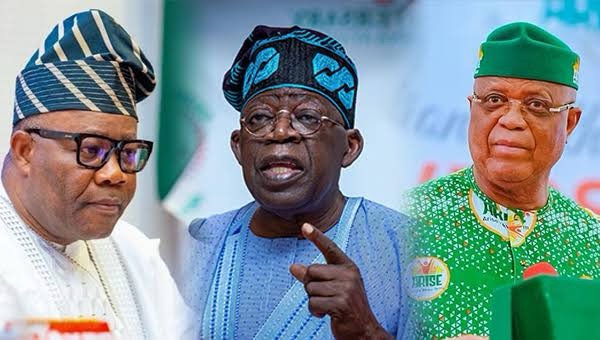
The political establishment surrounding President Bola Ahmed Tinubu, Senate President Godswill Akpabio and Governor Umo Eno appears to enjoy a combination of institutional advantages, political alliances, executive influence and strategic positioning that could prove difficult to overcome.
This is not necessarily a declaration of electoral victory before the ballot is cast. Rather, it is an assessment of the political forces shaping the road to 2027.
THE INSTITUTIONAL DIMENSION
One cannot examine the coming elections without considering the role of the Independent National Electoral Commission (INEC), now under the leadership of Professor Joash Amupitan. The leadership of the electoral institution is an important consideration in the national political equation.
However, the credibility of the electoral process must rest on constitutional independence, transparency and impartiality. No political establishment should presume to own the electoral institution. Ultimately, public confidence in INEC will be determined by its conduct.
THE SECURITY EQUATION
The prolonged security challenges confronting Northern Nigeria remain a significant political variable. Banditry, insurgency and other forms of insecurity have weakened communities, disrupted economic activities and complicated political mobilisation.
Any demonstrable success by the Tinubu administration in restoring security could substantially improve its political standing. Conversely, continued insecurity could become a formidable liability. The security question, therefore, remains central to the government’s electoral fortunes.
THE OPPOSITION’S ORGANISATIONAL DILEMMA
Perhaps one of the most consequential developments in the emerging political landscape is the organisational vulnerability of opposition parties.
Leadership disagreements, internal litigation, factional disputes and judicial complications have created considerable uncertainty within some opposition platforms.
In politics, ambition without organisation is often an exercise in futility. A fragmented opposition, regardless of its popularity or individual political personalities, may struggle to confront a ruling party with established national structures.
THE ETHNIC AND GEOPOLITICAL CALCULUS
Nigeria’s political reality cannot be separated from its ethnic, regional and geopolitical considerations. The country’s major political blocs have historically influenced electoral outcomes through negotiated alliances and strategic voting patterns.
The ability of the ruling establishment to maintain a broad coalition across these divides could be one of its greatest political assets. Nevertheless, ethnic solidarity is neither permanent nor absolute. Economic conditions, leadership credibility and public sentiment can redefine political loyalties.
THE GOVERNORS’ ALIGNMENT: A FORMIDABLE POLITICAL ASSET
The political disposition of state governors represents another important dimension of the 2027 equation.
Governors command considerable political influence through grassroots networks, party structures, administrative machinery and relationships with local political stakeholders.
A broad alignment of governors with the presidency can provide the ruling party with significant organisational advantages. But such advantages must be translated into public acceptance and genuine electoral support.
THE PRESIDENCY AND THE POLITICS OF INCUMBENCY
Perhaps the most consequential advantage available to President Tinubu is the institutional and political leverage associated with incumbency.
Presidential leadership influences national political conversations, policy direction, party relationships and the distribution of political responsibilities within the governing establishment.
The ability to sustain internal cohesion, manage competing interests and maintain strategic relationships across the federation will remain essential to the ruling party’s prospects.
For Senate President Godswill Akpabio, the strategic importance of legislative leadership and political coalition-building cannot be underestimated. Similarly, Governor Umo Eno’s position within Akwa Ibom’s evolving political landscape, particularly his relationship with the national governing establishment, gives him an important role in the emerging political configuration.
THE FINAL EQUATION
The 2027 elections may ultimately become a contest between political ambition and political structure, between opposition expectations and governing experience, and between the desire for change and the perceived advantages of continuity.
Tinubu, Akpabio and Umo Eno appear to occupy strategically advantageous positions within this emerging configuration. But political power is never permanently secured by alliances, incumbency or calculations alone.
The economy, national security, public confidence, institutional credibility and the people’s democratic choices will determine the final outcome.
Nevertheless, one thing is becoming increasingly evident: confronting an established political structure requires more than political declarations, temporary alliances and electoral optimism. It requires organisation, a convincing national alternative and the capacity to command public confidence.
For now, the political mathematics appears favourable to the governing establishment.
Only God knows tomorrow. But unless the unexpected intervenes, the road to 2027 may prove considerably more difficult for those hoping to dislodge the present political order.
