


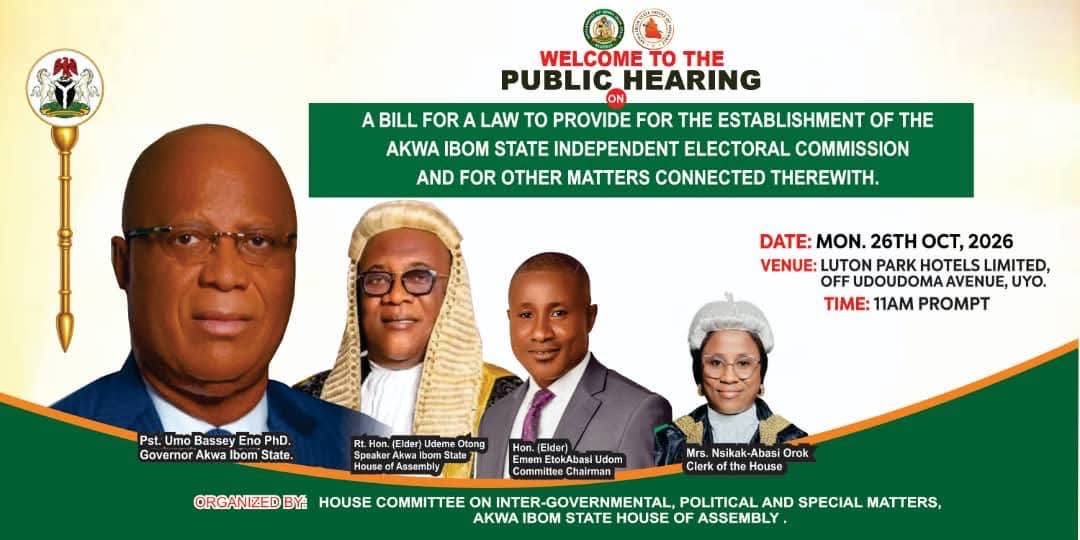
The Akwa Ibom State House of Assembly has held a public hearing on a bill seeking to establish the Akwa Ibom State Independent Electoral Commission (AKISIEC), with major proposals focusing on electoral credibility, institutional independence, renewable tenure for commission members, timely funding, transparent electoral procedures and inclusive participation ahead of the proposed 2027 local government elections.
The public hearing, organised by the House Committee on Inter-Governmental, Political and Special Matters on Monday, October 26, 2026, at Luton Park Hotel, Uyo, brought together electoral officials, political stakeholders, organised labour and other participants to examine the proposed legislation and contribute to the development of a sound legal framework for grassroots elections in the state.
Declaring the hearing open, the Speaker of the Akwa Ibom State House of Assembly, Rt. Hon. Udeme Otong, described the proposed legislation as an important initiative requiring careful scrutiny, constructive engagement and informed contributions to strengthen democratic institutions and promote public confidence in local government elections.
Hon. Otong, who commended the Chairman and members of the House Committee on Inter-Governmental, Political and Special Matters for facilitating the exercise, said local government councils remained the tier of government closest to the people, with responsibilities directly affecting the welfare, security and development of communities. He stressed that the process through which local government representatives emerge must inspire public confidence, encourage political participation and reflect the democratic aspirations of the people.
The Speaker emphasised that public hearings were vital to the legislative process, providing opportunities for the Legislature to listen to citizens, consider expert opinions and examine the practical implications of proposed laws before reaching a final decision.
He urged political parties, civil society organisations, legal practitioners, electoral stakeholders, community leaders and members of the public to make meaningful submissions, assuring them that their contributions would inform further legislative consideration of the bill.
Reaffirming the Assembly’s commitment to purposeful lawmaking, effective representation and responsible legislative oversight, Otong said the House, as the Pragmatic Assembly, remained determined to strengthen public institutions, advance the rule of law and promote the collective interests of Akwa Ibom people.
Earlier, the Chairman of the House Committee on Inter-Governmental, Political and Special Matters, Hon. Emem Udom, stated that the public hearing provided an opportunity for stakeholders to examine the proposed legislation, identify areas requiring clarification or amendment and make recommendations that would improve the state’s electoral framework.
Hon. Udom stressed that an independent, competent and credible electoral institution was essential to democratic governance, particularly at the grassroots, where elections determine the leadership responsible for addressing the immediate needs and aspirations of communities. He said the proposed law must clearly define the commission’s powers and responsibilities, establish appropriate institutional and operational arrangements, and provide for effective administration and funding.
The committee chairman further emphasised the need for the legislation to conform to applicable constitutional provisions while promoting transparency, accountability, fairness, impartiality and respect for the rule of law. He assured participants that their submissions would be considered objectively and called for constructive engagement towards developing a legal framework that strengthens democratic participation, promotes peaceful electoral competition and enhances public confidence in local government elections.
Presenting the position of AKISIEC, the Commission’s Secretary and Officer Covering the Duties of the Board Chairman, Dr. Uduak Udoh, said the executive bill sought to repeal the Akwa Ibom State Independent Electoral Commission Law, 2024, and harmonise the state’s electoral framework with the Electoral Act, 2026.
Dr. Udoh explained that a sound legal foundation was necessary to define responsibilities, establish transparent procedures, safeguard institutional independence and provide certainty for political parties, candidates, voters and other stakeholders. He said the proposed review would address inconsistencies, omissions and outdated provisions while preserving AKISIEC’s statutory mandate to organise, undertake and supervise elections into local government councils across the state.
Among the key proposals highlighted by the Commission was a five-year tenure for its members, renewable once for another five years, while the Secretary would serve a four-year term, also renewable once for another four years.
On electoral funding, AKISIEC proposed that funds required for elections constitute a first-line charge and be released at least 12 months before the next election, with disbursement permitted in tranches according to programme requirements. The Commission said adequate and timely funding would improve preparedness and support the effective discharge of its responsibilities.
The proposed bill also provides for the publication of an election notice not later than 300 days before polling day, the conclusion of political party primaries and submission of candidates’ lists at least 120 days before the election, and the commencement of public campaigns 150 days before polling, ending 24 hours before election day.
Other provisions highlighted by the Commission include the nomination of candidates through direct primaries or consensus, guidelines for political campaigns and clearer administrative responsibilities. AKISIEC also called for a complete listing of ministerial responsibilities under the relevant enabling statutes.
Emphasising inclusive electoral participation, the Commission said the proposed framework should support credible and accessible elections across the state’s 4,353 electoral units, 369 wards and 31 local government areas, ensuring that women, young people, senior citizens and persons with disabilities could exercise their voting rights freely and without discrimination.
Contributing to the discussion, the State Chairman of the Nigeria Union of Journalists (NUJ), Akwa Ibom State Council, Comrade Nsibiet John, called for the full release of election funds rather than their disbursement in tranches as proposed in the bill.
He argued that making the funds available in full would better support the Commission’s preparations and operational needs ahead of elections.
John also urged AKISIEC to establish a functional media unit and create an election situation room to provide timely updates on developments from the various local government areas while elections were ongoing.
He further advocated regular media briefings to keep the public informed, address concerns and promote transparency throughout the electoral process.
Meanwhile, the Resident Electoral Commissioner of the Independent National Electoral Commission (INEC), Prof. Anugbum Onuoha, represented by Barr. Vincent Ogene, pledged continued collaboration between INEC and AKISIEC to strengthen electoral administration and grassroots democratic participation.
Onuoha urged stakeholders to protect electoral infrastructure, including polling units, voter registration centres and other designated electoral facilities, warning against unauthorised interference with such facilities regardless of the status or influence of those involved.
Also speaking, the Akwa Ibom State Chairman of the Nigeria Labour Congress, Comrade Sunny James, advocated electronic voting as part of efforts to improve electoral administration.
The submissions from stakeholders are expected to assist the House Committee in its further consideration of the bill as the Akwa Ibom State House of Assembly continues efforts to establish an effective legal framework for local government elections, with emphasis on electoral credibility, institutional accountability, adequate funding, transparency and public confidence in the democratic process.
