


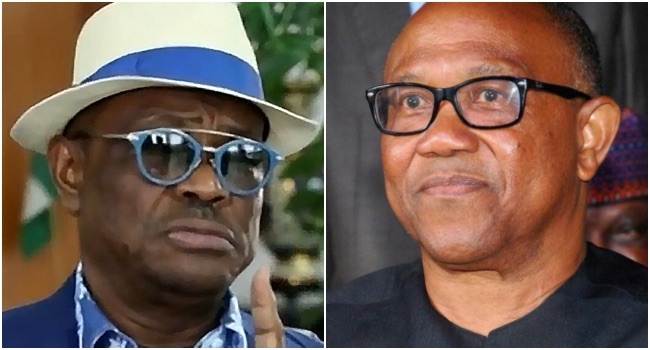
The political disagreement between Federal Capital Territory Minister Nyesom Wike and the Nigeria Democratic Congress (NDC) has intensified following a controversy involving its presidential candidate, Peter Obi, and the singing of Nigeria’s national anthem at a political gathering in Lagos.
Wike criticised Obi over a video reportedly showing him remaining seated while the current national anthem was being sung at an NDC town hall meeting, but standing when an alternative version of the anthem was performed by supporters.
Speaking on Friday at a political stakeholders’ meeting in Ogu-Bolo Local Government Area of Rivers State, Wike argued that Obi’s conduct raised questions about his respect for national symbols and his suitability to lead the country.
The minister maintained that a presidential aspirant should demonstrate respect for the country’s institutions and symbols, describing the incident as a matter of national unity and patriotism.
The NDC has rejected Wike’s criticism, describing it as politically motivated and questioning the minister’s authority to judge another politician’s commitment to national unity.
In a response issued by the party’s National Campaign Council spokesperson, Dr Chiogo Ikokwu, the NDC said the singing of the old national anthem was spontaneous and initiated by people at the gathering rather than planned or directed by Obi.
The party further argued that another part of the recording showed participants singing the current national anthem. It accused Wike of attempting to distract public attention from the country’s economic challenges and the performance of the APC-led government.
The exchange has turned what began as an incident at a political gathering into another public confrontation ahead of the 2027 general elections, with national identity, patriotism and political leadership now at the centre of the debate.
However, the competing interpretations should be distinguished from established facts. Wike’s comments represent his assessment of the incident, while the NDC’s explanation represents the party’s position. The available report does not establish that Obi deliberately rejected Nigeria’s national symbols.
As political campaigns gather momentum, the controversy highlights how symbolic gestures can become subjects of intense political interpretation. Voters will ultimately have to assess candidates on their policies, conduct and capacity to address the country’s challenges.
