


There is a difference between a government that merely occupies office and one that conceives governance as an opportunity to redefine the economic and social possibilities of its people. The difference is often reflected in the ideas it puts forward, the priorities it identifies, the institutions it strengthens and, most importantly, the future it imagines for the people it governs. In the life of a state, development must never be reduced to the excitement of commissioning projects or the ceremony of cutting ribbons. It must be about creating an environment in which people can live better, businesses can grow, opportunities can multiply and the next generation can inherit something more valuable than the circumstances of the present.
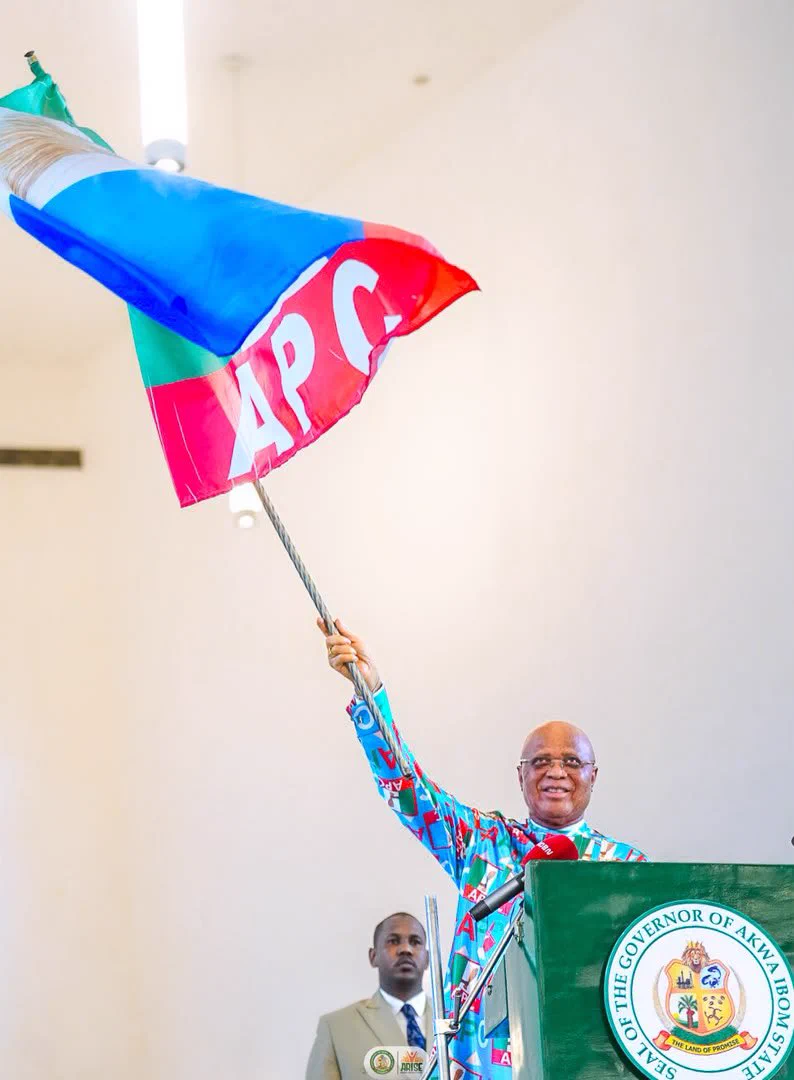
This is the broader conversation that Governor Umo Eno has introduced with the unveiling of ARISE Agenda 2.0.
At a time when governance is increasingly being measured by the capacity of subnational governments to stimulate economic growth, attract investments, create employment and improve living standards, the Akwa Ibom Governor has presented a development blueprint that looks beyond the immediate demands of governance. It is a roadmap for the proposed 2027–2031 administration, designed around the philosophy of consolidating existing gains and accelerating the state’s development aspirations.
The title, Consolidating Our Gains, Accelerating Our Rise, is particularly instructive. It communicates an understanding that development is not an isolated political event. It is a continuum. The achievements of today should become the foundations of tomorrow, just as the investments made in one administration should create opportunities that outlive the administration itself.
That is the philosophy behind ARISE 2.0, and it is important to understand it beyond the politics surrounding its unveiling.
When Governor Eno assumed office on May 29, 2023, he introduced the ARISE Agenda as the development philosophy of his administration. The agenda provided a framework for addressing infrastructure deficits, agricultural development, rural transformation, education, healthcare, social welfare and economic advancement. The new blueprint is designed to deepen these priorities while introducing a stronger emphasis on investment, industrialisation, commercial agriculture, tourism and private-sector participation.
In other words, the conversation is shifting from building the foundations of development to expanding the productive capacity of the state.
THE ECONOMY MUST WORK FOR THE PEOPLE
One of the most compelling arguments for ARISE 2.0 is its recognition that government cannot remain the principal employer and financier of economic activities. A state cannot achieve sustainable prosperity if its economic fortunes depend almost entirely on public expenditure.
This is where the emphasis on investment attraction, entrepreneurship, industrialisation and private-sector development becomes important.
Consider the young graduate in Uyo, Eket or Ikot Ekpene who has completed university education but is still searching for a meaningful economic opportunity. Consider the small business owner whose ambition is constrained by the cost of doing business, inadequate infrastructure and limited access to finance. Consider the trader who wants to expand beyond a neighbourhood market or the artisan who needs an enabling environment to turn a skill into a sustainable enterprise.
These are not abstract economic categories. They are real people whose aspirations should inform public policy.
A productive economy creates opportunities beyond government employment. It encourages businesses to expand, attracts investors, stimulates new industries and creates demand for different categories of skills.
This is why the administration’s intention to reposition Akwa Ibom as a commercial, industrial and tourism destination deserves attention. The objective is to create an economy in which government provides the enabling environment while private enterprise becomes an increasingly important partner in wealth creation.
AGRICULTURE: THE NEXT FRONTIER OF ECONOMIC OPPORTUNITY
Akwa Ibom cannot discuss economic diversification without taking agriculture seriously. The state has enormous agricultural potential, but potential becomes prosperity only when it is organised, financed, mechanised and connected to markets.
ARISE 2.0 proposes to deepen the Ibom Model Farm, Back-to-Farm Initiative, ARISE Home Farms Scheme and Equipment Leasing Facility. It also places emphasis on commercial farming, oil-palm plantations, agro-processing, modern agricultural technology and stronger farmer cooperatives.
There is something particularly important about this approach.
Agriculture should not be understood merely as the business of putting seeds into the ground and waiting for harvest. It is an entire economic ecosystem. It involves farm equipment, processing plants, storage facilities, transportation, packaging, distribution and access to markets.
When agriculture is properly organised, it creates opportunities for people who may never personally own a farm. It creates jobs for machine operators, food processors, transporters, marketers, technicians and entrepreneurs.
Imagine what it would mean for Akwa Ibom if agricultural production in the state could support a growing agro-industrial economy. Imagine farmers producing not merely for household consumption but for organised markets, processing companies and export opportunities.
That is the larger economic possibility behind the agricultural component of ARISE 2.0.
THE UYO CITY CENTRE: A NEW EXPRESSION OF URBAN DEVELOPMENT
Perhaps no component of the new blueprint captures its infrastructural ambition more visibly than the proposed Uyo City Centre Project.
The proposed development, which includes an elevated flyover, a two-level roundabout system, a CNG bus terminal, taxi and minibus facilities, commercial spaces, Ibom Plaza, a proposed City Tower and Ibom Mall, is intended to give Uyo a more modern transportation and commercial identity.
But beyond the physical structures, the economic implications deserve consideration.
A properly designed city centre can become a hub of commercial activities. It can improve movement, create business opportunities, attract investment and strengthen the capacity of the state capital to accommodate increasing economic activities.
Modern cities are not built simply to impress visitors. They are built to function, to facilitate commerce, to improve mobility and to create spaces where economic and social activities can flourish.
The proposed City Centre therefore represents an opportunity to think about Uyo beyond its present status as an administrative capital and towards its emergence as a stronger commercial destination.
RURAL AKWA IBOM MUST NOT BE LEFT BEHIND
There is also a compassionate dimension to ARISE 2.0 that deserves recognition.
The proposed 310 kilometres of rural roads, with 10 kilometres earmarked for each of the state’s 31 local government areas, alongside the expansion of the ARISE Compassionate Homes Programme to 1,000 homes, speaks to the importance of taking development closer to communities.
For someone living in a rural community, the importance of a good road is not measured in kilometres. It is measured in the time saved when taking a sick relative to the hospital, the ease with which farm produce reaches the market and the opportunities that become accessible when transportation improves.
Likewise, a decent home for a vulnerable family represents more than a construction project. It represents security, dignity and a measure of relief for people whose circumstances may have made decent accommodation difficult to obtain.
This is why rural development and social protection must remain important elements of any serious development agenda. A state cannot claim comprehensive development if the benefits of growth are concentrated only in its major urban centres.
EDUCATION AND HEALTHCARE: INVESTING IN THE HUMAN BEING
The most valuable resource of Akwa Ibom is not buried beneath its soil or located within its geographical boundaries. It is the people.
Every investment in education, healthcare, skills development and human capital is ultimately an investment in the productive capacity of the state.
The administration’s reported delivery of 35 Model Primary Schools, its free and compulsory education policy, examination support and tertiary education bursaries provide important foundations for the next phase.
ARISE 2.0 seeks to deepen these interventions while strengthening technical and vocational education, digital skills, innovation and employment pathways.
The objective should be clear: an Akwa Ibom child should not merely acquire certificates but should be equipped to compete, innovate and contribute to the economy.
Healthcare follows the same logic. The reported construction of 31 Primary Healthcare Centres, employment of healthcare personnel and expansion of health insurance coverage are important developments in improving access to medical services. The next phase proposes further investment in specialist healthcare, medical infrastructure and technology-driven service delivery.
For ordinary families, these investments have a very personal meaning. They speak to the possibility of accessing medical attention without exhausting family savings and to the assurance that children can receive quality education regardless of their parents’ economic circumstances.
IBOM DEEP SEAPORT AND THE ECONOMIC FUTURE OF AKWA IBOM
There is another major opportunity that gives ARISE 2.0 a broader economic outlook: the Ibom Deep Seaport.
For a coastal state with the geographical advantages of Akwa Ibom, maritime development should naturally form part of its long-term economic imagination.
A functional deep seaport has the potential to stimulate maritime transportation, logistics, warehousing, manufacturing, trade and other supporting industries. It could expand the economic reach of the state beyond its immediate geographical boundaries.
The Governor’s emphasis on the project, including his acknowledgment of federal support and progress in relevant certification and approval processes, reflects the administration’s intention to pursue a major economic asset that could reshape the state’s commercial outlook.
Its importance should not be measured only by the size of the proposed facility but by the economic activities it can generate and the opportunities it can create for Akwa Ibom people.
The same applies to tourism. With its hospitality industry, cultural heritage, natural attractions, cuisine and entertainment potential, Akwa Ibom has the ingredients to become a major destination for conferences, holidays, sports and cultural events.
The development of Destination Akwa Ibom, alongside existing tourism assets and new investments, provides an opportunity to make tourism a more organised contributor to the state’s economy.
WHY CONTINUITY AND CONSOLIDATION MATTER
There is a tendency in political discourse to treat every new administration as though development must begin from the beginning. This is not how sustainable societies are built.
The most successful development processes are often those in which successive phases build upon existing foundations, improve what has been achieved and introduce new ideas where necessary.
This is the significance of consolidation in the ARISE 2.0 philosophy.
A road network must support commerce. A school must produce quality learning outcomes. A healthcare facility must deliver effective medical services. Agricultural investments must translate into increased productivity. Youth empowerment must create pathways to sustainable livelihoods.
The four principles associated with the new agenda — Performance, Character, Consolidation and Continuity — provide a framework for understanding the administration’s stated priorities.
Performance speaks to delivery and measurable results. Character speaks to the values that should guide public leadership. Consolidation speaks to strengthening existing investments, while continuity recognises that development requires consistency, institutional memory and long-term planning.
These are important considerations in a state seeking to move from an economy substantially dependent on public-sector activities towards one with a stronger productive and investment base.
THE ARISE 2.0 PROPOSITION
What makes the new blueprint particularly interesting is the relationship between its different components. Agriculture is connected to industrialisation. Rural roads are connected to market access. Tourism is connected to hospitality and employment. Education is connected to human capital development. The proposed seaport is connected to trade and logistics, while the Uyo City Centre is connected to urban commerce and transportation.
It is this interconnectedness that gives the agenda its broader development character.
The real challenge, as with every ambitious development plan, will be implementation, financing, coordination and measurable delivery. Citizens will understandably expect the proposed targets to translate into visible improvements in their communities and economic circumstances.
But the significance of having a defined roadmap should not be overlooked. It provides a basis for planning, public engagement, resource prioritisation and accountability.
Akwa Ibom is at a point where the conversation must increasingly be about how to expand its economic possibilities, strengthen its institutions and create opportunities that will endure beyond individual political tenures.
Governor Umo Eno’s ARISE Agenda 2.0 has placed these questions at the centre of its proposed next phase.
The people of Akwa Ibom have every reason to take an interest in the blueprint, understand its proposals and engage with its development objectives. Its success will require not only government commitment but also the participation of the private sector, traditional institutions, professional bodies, communities, young people, women and other stakeholders.
A development agenda becomes meaningful when the people see themselves in it. It becomes sustainable when businesses can participate in it, communities can benefit from it and future generations can build upon it.
Perhaps, therefore, the most important message of ARISE 2.0 is not simply that Akwa Ibom has another development blueprint. It is that the state is setting out to build on its existing foundations with a broader economic ambition.
The aspiration is an Akwa Ibom where agriculture is productive, infrastructure supports enterprise, education creates possibilities, healthcare protects families, tourism generates wealth, industry expands employment and rural communities share in the benefits of development.
That is a future worth discussing, examining and working towards.
ARISE 2.0: CONSOLIDATING OUR GAINS, ACCELERATING OUR RISE.
THAT SAME GOD!
