


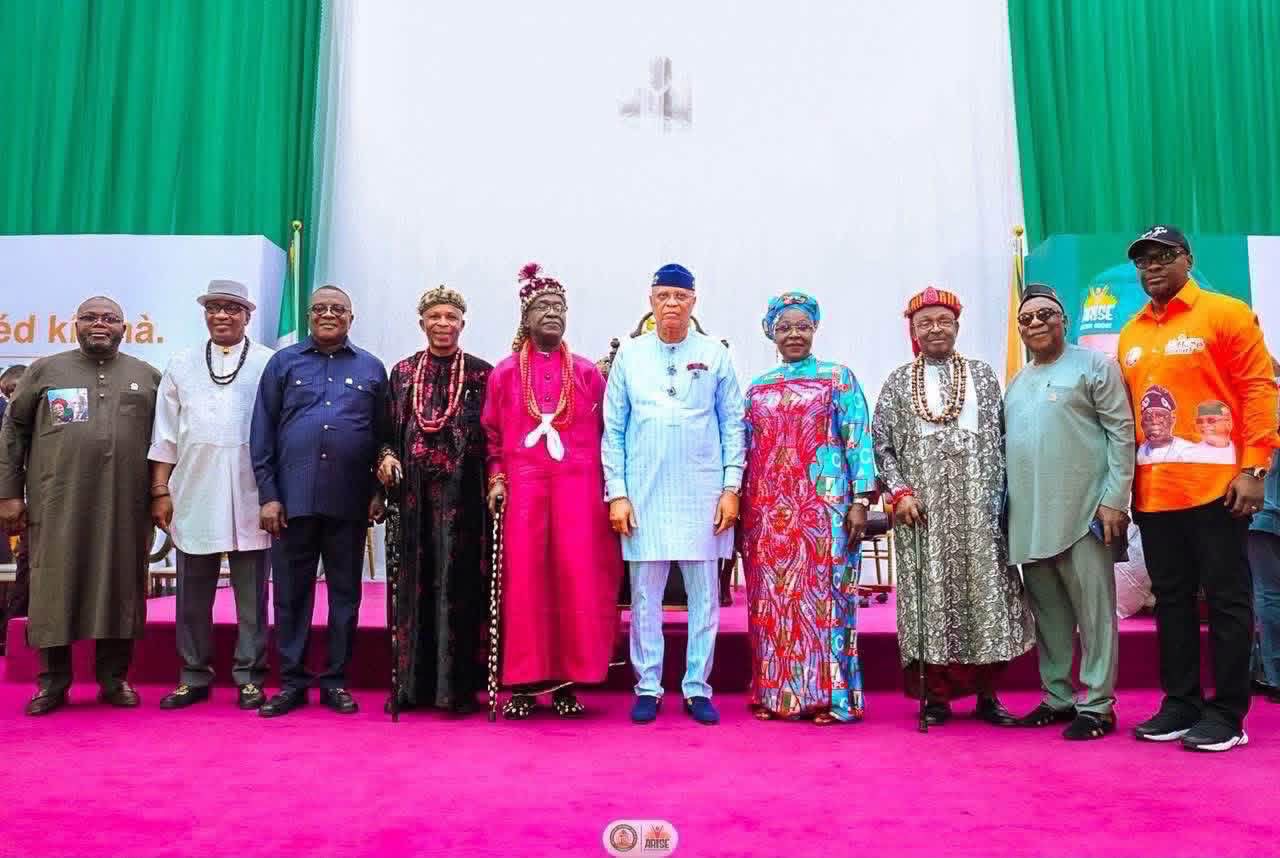
Beyond the political significance of their endorsement of Governor Umo Eno’s second-term ambition, the recent consultation between the Governor and traditional rulers in Akwa Ibom State offers an opportunity to examine a defining feature of his administration: a deliberate commitment to respecting, honouring and restoring the pride of the traditional institution in the state’s governance structure.
At a time when traditional institutions in many parts of the country are increasingly concerned about their relevance in modern governance, the Umo Eno administration appears to have taken a different approach by recognising royal fathers not merely as custodians of culture and tradition, but as indispensable partners in grassroots development, peacebuilding and community mobilisation.
This disposition was once again demonstrated when Governor Eno visited the Traditional Rulers Chambers in Uyo, where royal fathers, under the umbrella of the Akwa Ibom State Supreme Council of Traditional Rulers, received him with prayers, royal blessings and assurances of support for his 2027 re-election bid.
The President-General of the Supreme Council and Oku Ibom Ibibio, Ntenyin Dr Solomon Etuk, did not mince words in acknowledging the Governor’s leadership disposition. He commended the administration for responsible and transparent governance, particularly its commitment to due process in project execution, where funds are approved before contracts are awarded and payments made in line with established procedures.
For the traditional ruler, such an approach provides safeguards against abandoned projects and promotes accountability in public expenditure. He also applauded the prevailing peace in the state and the welfare interventions extended to traditional rulers, describing them as evidence of an administration that recognises the importance of the traditional institution.
The Chairman of the Supreme Council and Paramount Ruler of Abak Local Government Area, HRM Akuku Saviour Udofia, alongside his predecessor and Paramount Ruler of Udung Uko, HRM Odidem Bassey Etim Edet, also expressed appreciation for the Governor’s leadership, particularly his community-based projects, support for senior citizens and welfare packages for royal fathers.
Their commendations were not merely expressions of courtesy. They reflected an appreciation of a relationship that has, over the past three years, placed traditional rulers within the broader conversation on development and governance.
Indeed, one of the commendable aspects of Governor Eno’s administration is its understanding that development cannot be sustained by government policies and infrastructure alone. It requires the cooperation of institutions that enjoy the trust, confidence and cultural authority of the people. In Akwa Ibom, traditional rulers occupy that strategic position.
By extending official vehicles, a coaster bus, personal assistants, quarterly medical assistance, 13th-month allowances and other welfare interventions to the royal fathers, the administration has demonstrated that the traditional institution deserves more than ceremonial recognition. These gestures, while not a substitute for the constitutional responsibilities of elected officials, represent practical efforts to preserve the dignity, mobility and welfare of those who occupy traditional stools.
More importantly, Governor Eno’s assurance that traditional rulers would continue to enjoy their pride of place and receive greater recognition in his proposed second term sends a reassuring message about the place of the institution in his vision for the state.
His appeal to the royal fathers to promote peace, unity, political understanding and support for development initiatives also reinforces the fact that traditional rulers remain important links between government and the grassroots. Their influence in communities can help bridge communication gaps, resolve disputes, discourage social unrest and encourage citizens to participate constructively in government programmes.
However, respect for traditional institutions must ultimately be measured not only by the courtesies extended to royal fathers but also by the tangible improvements in the lives of the people they lead. This is where the administration’s wider development agenda becomes significant.
A few days before the royal consultation, Governor Eno approved the implementation of solar-powered water projects across all 369 wards of Akwa Ibom State under the ARISE-GIFA initiative. The approval, disclosed by the Commissioner for Information, Rt. Hon. Aniekan Umanah, PhD, followed the State Executive Council meeting of November 11, 2026.
The proposed statewide intervention is particularly significant because access to potable water remains one of the most essential indicators of community wellbeing. By extending the initiative to all 369 wards, the administration is demonstrating an understanding that development must reach beyond major urban centres and touch ordinary people in their immediate communities.
For traditional rulers, who daily encounter the challenges confronting their subjects, such interventions are especially meaningful. Access to clean water will reduce the burden on households, improve sanitation, support public health and enhance the quality of life in rural communities. It also provides another opportunity for traditional institutions to work with government in identifying community needs and ensuring that development projects deliver their intended benefits.
This grassroots approach is consistent with the philosophy of the ARISE Agenda, which places emphasis on agricultural development, rural transformation, infrastructure, security and education. It is a development framework that recognises the interconnectedness of communities and the need to distribute opportunities across the state.
Governor Eno’s consultation with traditional rulers also comes against the backdrop of the Federal Government’s recent approval for the actualisation of the Ibom Deep Seaport project. Explaining the significance of the approval, the Governor clarified that it goes beyond permission to negotiate or obtain a licence, as it provides for the Federal Government’s Sovereign Guarantee and equity participation, critical requirements for attracting investors.
His confidence that Akwa Ibom could emerge as a major investment destination before the end of his proposed second term in 2031 reflects an administration seeking to combine grassroots development with strategic economic expansion.
The Governor’s decision to announce Mkpat Enin as the starting point of his second-term campaign on November 16, 2026, was also presented as a strategic gesture of respect for his wife’s place of origin. While the consultation was politically significant, it equally provided an opportunity to renew the partnership between government and the traditional institution.
It is important to acknowledge that traditional rulers are not elected politicians, and their relevance transcends electoral cycles. They remain custodians of the people’s heritage, history, customs and values. Their palaces are often the first points of contact for citizens seeking intervention in community disputes, family disagreements and other grassroots challenges. Consequently, any administration that appreciates their contributions to peace and social stability deserves commendation for giving the institution the recognition it deserves.
Governor Eno’s approach is particularly commendable because it reinforces the dignity of the traditional stool without attempting to diminish its cultural independence. His engagement recognises that government and traditional institutions have complementary responsibilities in building a peaceful and prosperous society.
The royal blessings and assurances of support received by the Governor may have immediate political implications as the 2027 election approaches, but the more enduring significance lies in the relationship between the state government and the custodians of its cultural heritage.
As Akwa Ibom moves towards another electoral season, the priority should remain the preservation of peace, continuity in development and the strengthening of institutions that hold communities together. The Governor’s call for unity, alongside his assurance of improved welfare for traditional rulers, provides a basis for sustaining that partnership.
Ultimately, a government is remembered not only for the roads it constructs, the buildings it commissions or the investments it attracts, but also for the institutions it strengthens and the people it honours.
By consistently recognising the traditional institution as an important stakeholder in governance, extending practical welfare support to royal fathers and taking development initiatives to the grassroots, Governor Umo Eno is making a statement about the kind of relationship government should maintain with its traditional authorities.
The royal fathers have offered their blessings and expressed confidence in his leadership. For the people of Akwa Ibom, the greater expectation is that this relationship will continue to translate into peaceful communities, improved living conditions and inclusive development across all 31 local government areas.
In a society where respect for tradition remains central to communal identity, Governor Eno’s recognition of the traditional institution is not merely a political gesture; it is an investment in the cultural heritage, unity and stability of Akwa Ibom State.
