


There is a fundamental difference between building public infrastructure and establishing the institutional framework required to preserve, manage, maximise and sustain its value. Unfortunately, this distinction is often overlooked in our approach to governance and public-sector development.
The construction of public infrastructure is important, but the sustainability of such infrastructure is even more important. A government that builds without thinking about maintenance, management, commercial viability and long-term utilisation may simply be creating liabilities for future administrations.
This is one of the reasons I strongly believe that establishing an Ibom Parks and Gardens Management Agency (IPGMA) is not merely desirable but sacrosanct, particularly given the emerging tourism and recreational infrastructure in Akwa Ibom State.
People who are fond of defending government at all costs may want to dismiss this proposal by arguing that the Akwa Ibom State Environmental Protection and Waste Management Agency (AKSEPWMA) can perform the same functions. While I acknowledge that there are areas of convergence between the two institutions, I respectfully disagree that they are interchangeable.
The fact that both institutions have responsibilities connected to the environment does not make their mandates identical. There are clear distinctions in their core responsibilities, operational priorities, professional requirements and intended outcomes.
Let us examine this.
- AKSEPWMA AND THE PROPOSED IBOM PARKS AND GARDENS MANAGEMENT AGENCY: UNDERSTANDING THE DISTINCTION
The Akwa Ibom State Environmental Protection and Waste Management Agency, established under Cap. 47 of the Akwa Ibom State Laws, 2000, has a broad environmental protection, sanitation and waste-management mandate.
Its statutory responsibilities include:
- Advising government on environmental policies, priorities and matters affecting the state’s ecosystem.
- Identifying and providing solutions to environmental protection challenges.
- Planning, monitoring and implementing environmental protection programmes.
- Promoting environmental education and public awareness.
- Monitoring and enforcing environmental standards and regulations.
- Managing waste disposal and ensuring regular evacuation of refuse from public places and residential premises.
- Ensuring the cleanliness of highways, roads, streets and other public spaces.
- Trimming grass and other overgrown vegetation along roads and public thoroughfares.
- Clearing public drains and ensuring effective drainage.
- Conducting sanitary inspections of premises.
- Monitoring pollution, industrial waste disposal, petroleum spillage and other environmental hazards.
- Conducting environmental impact assessments and providing technical recommendations.
These are critical responsibilities, and I do not subscribe to the idea that establishing another agency should undermine or diminish the importance of AKSEPWMA.
However, let us ask a fundamental question: Is the management of public parks, botanical gardens, recreational centres, landscaped gardens, nature parks, tourism gardens and other designated green spaces adequately captured by the existing agency’s primary institutional mandate?
This is where the proposed Ibom Parks and Gardens Management Agency becomes necessary.
- WHAT SHOULD THE IBOM PARKS AND GARDENS MANAGEMENT AGENCY DO?
Unlike an institution whose primary responsibility revolves around environmental protection, sanitation and waste management, the proposed agency should have a specialised mandate to develop, manage, maintain and commercially optimise public parks, gardens and recreational infrastructure across the state.
Its responsibilities should include, but not be limited to, the following:
A. Identification and Development of New Parks
- Discovering and identifying suitable locations across the 31 local government areas for the development of public parks and gardens.
- Conducting feasibility studies, environmental assessments and land-use planning for proposed recreational spaces.
- Developing partnerships with private investors, landscape architects, horticulturists, tourism professionals and other relevant stakeholders.
- Promoting the development of community parks, botanical gardens, nature parks and recreational centres.
B. Management and Maintenance of Existing Parks and Gardens
- Managing and maintaining government-owned parks, gardens and recreational facilities.
- Developing standard operating procedures for the maintenance of landscaped environments, lawns, trees, flowers, walkways, fountains and other park facilities.
- Ensuring the protection of park infrastructure against vandalism, misuse and deterioration.
- Engaging qualified professionals in horticulture, landscape architecture, facility management and recreational services.
- Establishing maintenance schedules, service standards and performance indicators for every facility under its supervision.
C. Tourism Promotion and Destination Development
- Positioning Akwa Ibom as a destination for leisure, recreation, nature tourism and family holidays.
- Developing attractive recreational experiences for residents, domestic tourists and international visitors.
- Organising cultural festivals, outdoor exhibitions, recreational events and other tourism-related activities.
- Collaborating with the Ministry responsible for Tourism, private hospitality operators, tour companies and other relevant institutions.
- Promoting the state’s natural attractions and integrating them into a coordinated tourism development strategy.
D. Commercialisation and Revenue Generation
- Developing sustainable revenue models for government-owned parks and gardens.
- Introducing appropriate entrance fees, recreational subscriptions, event-hosting charges and other approved commercial activities.
- Attracting private-sector participation through concessions, public-private partnerships and investment arrangements.
- Ensuring that government-owned recreational assets generate economic value without compromising public access.
- Establishing transparent financial reporting and accountability mechanisms.
E. Youth Employment and Economic Opportunities
- Creating direct employment opportunities for horticulturists, gardeners, landscape architects, facility managers, tour guides, security personnel and administrative professionals.
- Providing opportunities for small businesses involved in landscaping, gardening, event management, catering, photography, recreational equipment and other related services.
- Encouraging youth entrepreneurship through vocational training and business opportunities within the parks and gardens value chain.
- Promoting local businesses and indigenous enterprises as service providers.
F. Environmental Sustainability and Urban Greening
- Promoting tree planting, biodiversity conservation and the preservation of indigenous plant species.
- Developing green spaces that contribute to improved urban aesthetics and environmental sustainability.
- Collaborating with AKSEPWMA on environmental standards, waste management, pollution prevention and sanitation within parks.
- Promoting climate-conscious landscaping and sustainable water-management practices.
These are not merely beautification activities. They are economic, social, environmental and tourism-development interventions.
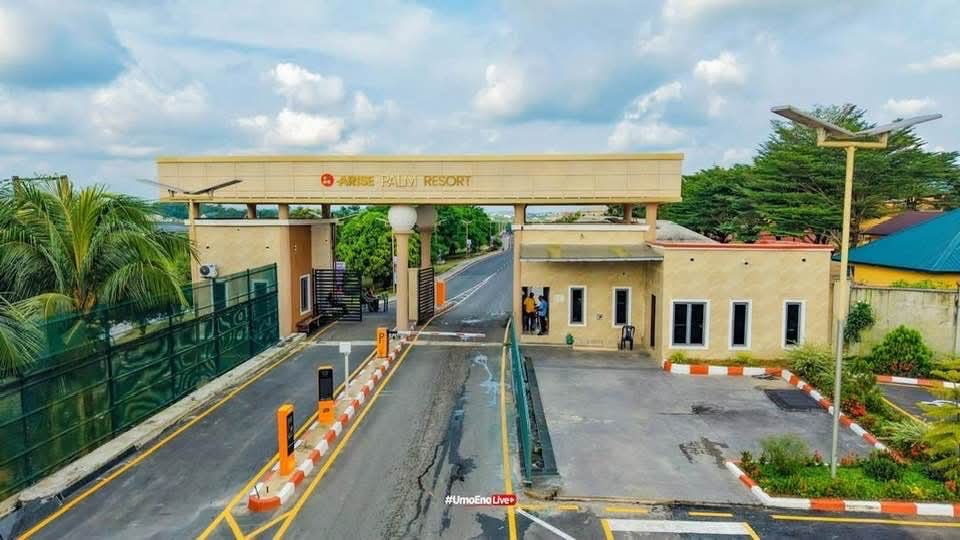
- ARISE PALM RESORT: A MICROCOSM OF AKWA IBOM’S TOURISM POTENTIAL
Having welcomed the conceptualisation and eventual completion of the Arise Palm Resort, I believe it is important to put some personal context on record.
Sometimes in May 2023, I personally forwarded the idea of building a Nature Park in Akwa Ibom State to Pastor Umo Eno through his then WhatsApp number and also through other persons close to him.
I went as far as engaging an architect, at my own expense, to develop a proposed land-use zoning design, complete with suggested features, which I forwarded alongside my communication. He later announced in August 2023, the establishment of Arise Palm Resort.
The Governor decided to transform the erosion-ravaged ravine in Uyo into a recreational and tourism destination in late 2024, even though my proposed site then was the green river area in Ibesikpo Asutan Local Government Area.
I was therefore genuinely proud and happy when the administration decided to transform that previously degraded landscape into what has become the Arise Palm Resort.
For me, it was more than the construction of another government project. It was an opportunity to demonstrate that even environmentally challenged locations could be transformed into productive assets capable of generating economic value, attracting visitors, creating jobs and giving our people something to be proud of.
But here is the critical point: The completion of Arise Palm Resort should not be the end of the vision. It should be the beginning of a more comprehensive tourism-development strategy.
A resort of this nature requires professional management, consistent maintenance, effective marketing, security, investment in recreational activities and a sustainable business model.
Beyond its physical structures, what experiences does it offer visitors? What makes people want to return? What opportunities does it create for local businesses? What is its annual revenue projection? How many jobs does it support? What is the maintenance budget, and who is responsible for ensuring that the facilities remain attractive and functional five, ten or twenty years from now?
These are the questions that should occupy our minds.
I would like to see the resort developed into a more comprehensive recreational destination with additional attractions such as a zipline adventure course, carefully designed nature trails, family recreation areas, children’s play facilities, outdoor event spaces and other activities that can appeal to different categories of visitors.
Even the entrance and surrounding landscape should communicate the beauty, uniqueness and recreational identity of the destination.
We must move beyond constructing facilities to creating experiences.
- WHY I STILL CRITICISE THE GOVERNMENT DESPITE WELCOMING THIS PROJECT
Some people may wonder why I continue to criticise the administration of Governor Umo Eno despite acknowledging and welcoming projects such as the Arise Palm Resort.
Well, I have no personal issues with the Governor. My concerns are about the pace of development, the quality of governance, the lack of sufficient transparency in public procurement and contract awards, and the government’s inability to consistently provide citizens with timely and verifiable information about its activities.
I believe government must be accountable, whether it is doing well or falling short.
Acknowledging a good project does not mean surrendering one’s responsibility to question other aspects of governance. Equally, criticising an administration does not mean refusing to acknowledge its achievements.
These two positions are not contradictory. They are essential ingredients of responsible citizenship.
My concern is that Akwa Ibom cannot afford to measure development merely by the number of projects commissioned, the political excitement surrounding their unveiling or the publicity generated around them.
We must begin to measure development by outcomes, sustainability, economic impact, institutional effectiveness and the improvement of citizens’ quality of life.
This brings me to another important issue: leadership.
- THE LEADERSHIP QUESTION: BEYOND PROJECT COMMISSIONING TO TRANSFORMATIONAL GOVERNANCE
One of the most influential leadership theories is Transformational Leadership Theory, introduced by American political scientist and historian James MacGregor Burns in his 1978 book, Leadership, and subsequently developed by Bernard M. Bass.
Burns distinguished between transactional leadership, which is largely based on exchanges and immediate interests, and transforming leadership, which elevates the aspirations, values and moral commitments of both leaders and followers.
Bass subsequently identified four major dimensions of transformational leadership:
- Idealised Influence: Leaders must demonstrate integrity, credibility and exemplary conduct that inspire public confidence.
- Inspirational Motivation: Leaders must articulate a compelling vision and inspire people to work towards a shared future.
- Intellectual Stimulation: Leaders must encourage innovation, critical thinking, fresh ideas and the willingness to challenge outdated approaches.
- Individualised Consideration: Leaders must recognise people’s different needs, develop talent and create opportunities for individual growth.
These principles are particularly relevant to governance.
A transformational leader does not merely commission projects; such a leader builds institutions, strengthens systems, encourages innovation, promotes accountability and creates opportunities for people to participate in the development process.
A transformational leader also understands that governance is not about the personality of the officeholder. It is about building systems that will continue to deliver value long after the officeholder has left.
This is the kind of leadership Akwa Ibom needs.
The Governor should not be the only person expected to conceptualise development ideas. The administration must create an environment where citizens, professionals, investors, researchers and development advocates can contribute meaningfully to the state’s progress.
Ideas should be evaluated on their merit, not on the political identity or proximity of their originators.
That is how progressive societies build.
- THE ECONOMIC ARGUMENT: PARKS AND GARDENS ARE NOT JUST BEAUTIFICATION PROJECTS
There is a tendency in our society to regard parks and gardens as luxury projects or mere beautification exercises. That understanding is rather limited.
Modern parks and recreational facilities are economic assets.
They stimulate hospitality, transportation, food services, entertainment, event management, photography, tourism, retail businesses and other commercial activities.
Consider what happens when a properly managed recreational destination attracts hundreds or thousands of visitors.
People pay for transportation. They patronise restaurants. They purchase refreshments. They book accommodation. They hire tour guides. They buy souvenirs. They engage photographers. They participate in recreational activities.
Behind every successful tourism destination is an economic value chain that supports several categories of businesses and workers.
This is precisely the opportunity Akwa Ibom must begin to explore.
Imagine a network of well-managed parks and gardens across the state, strategically developed around our natural attractions, cultural heritage, coastal assets and urban centres.
Imagine well-maintained recreational parks in Uyo, Eket, Ikot Ekpene, Oron and other strategic locations, with community-level parks in our local government areas.
Imagine botanical gardens that preserve indigenous plants, educational nature parks where children learn about biodiversity, and family recreation centres that provide safe and affordable leisure opportunities.
Imagine these facilities attracting visitors from neighbouring states and beyond.
That is economic development.
And it is achievable with proper planning, professional management, strategic investment and political commitment.
- THE WAY FORWARD: ESTABLISH AN AGENCY WITH A CLEAR MANDATE AND ACCOUNTABILITY FRAMEWORK
I am proposing that the Akwa Ibom State Government establish the Ibom Parks and Gardens Management Agency through an appropriate legal framework.
However, establishing another agency must not become an excuse to expand government bureaucracy or create additional political appointments without corresponding value.
The proposed agency must be professionally constituted, adequately funded and driven by measurable performance indicators.
Its mandate should be clearly separated from that of AKSEPWMA, while providing for institutional collaboration where their responsibilities intersect.
For instance:
- AKSEPWMA should retain its statutory responsibility for environmental protection, sanitation, waste management, pollution control and relevant vegetation-control functions.
- Ibom Parks and Gardens Management Agency should focus on the development, management, maintenance, commercialisation and tourism utilisation of designated public parks, gardens and recreational assets.
- The Ministry responsible for Tourism should provide policy direction and coordinate the broader tourism-development agenda.
- The Ministry responsible for Environment should provide relevant environmental policy oversight and technical coordination.
- Private-sector investors should be encouraged to participate through transparent and properly structured investment arrangements.
The agency should also publish an annual performance report detailing:
- Number of parks and gardens developed or maintained.
- Visitor numbers and tourism growth.
- Revenue generated and expenditure incurred.
- Number of direct and indirect jobs created.
- Private-sector investments attracted.
- Maintenance performance and infrastructure conditions.
- Environmental sustainability outcomes.
This is how we move from political announcements to measurable development.
- IPGMA IS NOT A SUBSTITUTE FOR A DEDICATED ARISE PALM RESORT MANAGEMENT TEAM
Let me make one important clarification so that my proposal is not misunderstood.
The establishment of the Ibom Parks and Gardens Management Agency should not, in any way, prevent the government from setting up a dedicated and professionally constituted management team for the Arise Palm Resort.
These are two different but complementary institutional arrangements.
The Arise Palm Resort, given its size, investment, tourism potential and operational requirements, deserves a dedicated management structure responsible for its day-to-day administration, facility operations, customer experience, marketing, revenue generation, security, maintenance and overall commercial performance.
It should have clearly defined management responsibilities, operational targets and measurable key performance indicators. Its management must be held accountable for the quality of services delivered, the resort’s financial performance and the preservation of its facilities.
However, the proposed Ibom Parks and Gardens Management Agency has a much wider mandate than the management of one resort.
IPGMA should be a supporting and coordinating institution responsible for the continuous discovery, development, maintenance, preservation and strategic utilisation of parks, gardens and designated recreational green spaces across Akwa Ibom State, including the Arise Palm Resort.
In practical terms, while the dedicated Arise Palm Resort management team handles the resort’s daily operations, IPGMA should provide broader institutional support through professional standards, landscape development expertise, maintenance frameworks, technical coordination, recreational development initiatives and the promotion of a coordinated parks and gardens network across the state.
The distinction is important.
We cannot establish an agency whose entire existence revolves around one resort when the development opportunities across our 31 local government areas are much broader.
IPGMA should be looking beyond Arise Palm Resort. It should be identifying new locations for parks and gardens, developing existing recreational spaces, preserving natural attractions, promoting urban greening and creating a network of attractive destinations that can collectively strengthen Akwa Ibom’s tourism economy.
In other words, Arise Palm Resort should have its own management team, while IPGMA should serve as the broader institutional framework supporting the development and sustainability of parks and gardens across the state.
One is responsible for the efficient operation of a particular destination; the other is responsible for advancing a wider state-level parks and gardens development agenda.
Both are necessary, and neither should be used as an excuse to dispense with the other.
CONCLUSION: LET US BUILD INSTITUTIONS THAT OUTLIVE GOVERNMENTS
Akwa Ibom has enormous tourism potential. We have natural attractions, cultural heritage, a beautiful landscape, coastal opportunities and an emerging collection of recreational and hospitality assets.
What we need is a deliberate strategy to discover these opportunities, design sustainable development models around them and deliver results that can be measured.
The Arise Palm Resort is an opportunity. But it should not become an isolated achievement. It should be part of a wider tourism and recreational development framework.
The proposed Ibom Parks and Gardens Management Agency is therefore not an unnecessary duplication of AKSEPWMA. It is a specialised institutional intervention that can complement existing environmental institutions while addressing a distinct development need.
Let us be clear: governments come and go, but institutions must remain. Political administrations have limited tenures, but the assets they create should serve generations.
I welcome the Arise Palm Resort. I commend the transformation of that erosion-ravaged landscape. But I will continue to ask questions about its management, sustainability, economic returns and the broader pace of development in our state.
That is not hostility. It is responsible citizenship.
Akwa Ibom must move from building projects to building sustainable development systems. We must move from beautification to economic utilisation, from political announcements to institutional accountability, and from isolated achievements to a coordinated tourism economy.
The time to establish the Ibom Parks and Gardens Management Agency is now.
